
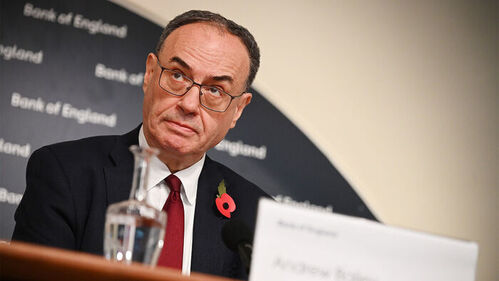

▲ Andrew Bailey, Governor of the Bank of England
The Bank of England (BOE), the central bank of the United Kingdom, raised its benchmark interest rate by 0.25 percentage points to 4.00 percent at its Monetary Policy Committee meeting on the 5th local time.
This marks the first interest rate hike by the UK in 3 years and 3 months, following a 0.25 percentage point increase to 5.25 percent in August 2023.
Among the nine members of the Monetary Policy Committee, eight voted in favor of the 0.25 percentage point rate hike, while one member cast a dissenting vote for a 0.5 percentage point increase to 4.25 percent.
Market experts surveyed earlier by Reuters had forecast a 7-to-2 split in favor of the hike, which is interpreted as a reflection of a more hawkish stance than expected.
The benchmark interest rate of 5.25 percent in August 2023 was the highest level in 15 years.
Since then, the Bank of England has either maintained or cut interest rates.
Beginning with a 0.25 percentage point cut last December, it kept rates frozen for six consecutive months from January to September of this year.
Inflationary pressures have persisted since the outbreak of the Iran war in February of this year.
The consumer price inflation rate for September stood at 3.5 percent, significantly exceeding the bank's 2 percent target and reaching an 11-month high.
In its statement, pointing to the continuous rise in global energy prices stemming from the Middle East conflict entering its ninth month, the Bank of England projected that the UK Consumer Price Index (CPI) inflation rate would rise to nearly 5 percent by the middle of next year.
The Bank of England explained, "While the direct impact of rising energy prices is clear and will continue to be reflected in the energy costs of businesses and households, signs of knock-on effects on other prices or wages remain limited," adding, "The current level of ongoing inflationary pressures is sufficient to justify a rate hike."
In addition, Governor Andrew Bailey stated, "Today's increase is inevitable and should not be seen as the beginning of a succession of rate hikes," but also noted, "However, if the Middle East war is not resolved, it also does not appear to be the final hike."
Governor Bailey also said, "If there is no news to alleviate the risks of inflationary pressures, it is sensible to raise interest rates further and subsequently adopt a conditional approach based on evidence of energy prices and inflation dynamics."
According to the economic outlook presented by the Bank of England on this day, CPI inflation is expected to peak at 4.9 percent in the second quarter of next year—the highest level since September 2023—before falling below 2 percent only in 2029.
It projected 4.5 percent for the first quarter of next year, which is more than 1 percentage point higher than the forecast made in July of this year (3.2 percent).
Since the outbreak of the Middle East war, the Bank of England has presented different economic scenarios depending on the course of the conflict, expecting that in the worst-case scenario where tensions continue to escalate, the inflation rate in the third quarter of next year could reach 6.2 percent.
The Bank of England projected that the UK's gross domestic product (GDP) this year would grow by 1.6 percent compared to last year, revising it upward from the previous forecast of 1.1 percent, and raised next year's economic growth rate forecast from 1.1 percent to 1.3 percent.
However, the growth rate for 2028 was lowered from 1.7 percent to 1.2 percent.
Previously, the European Central Bank (ECB) raised its three key policy rates by 0.25 percentage points twice in June and September, while keeping them unchanged last month.
(Photo: AP, Yonhap News)

